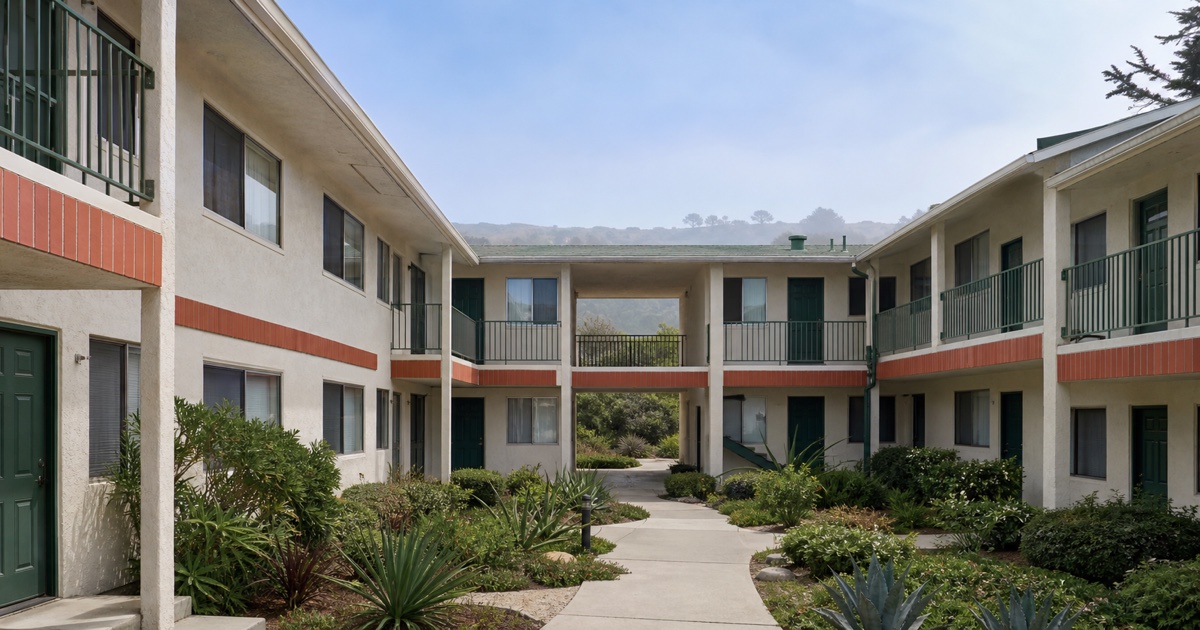
For a covered property, an owner or manager may need to coordinate:
- Property and unit coverage.
- Required lease provisions.
- Resident notice.
- Signs at entrances, exits, common areas, and property boundaries.
- Any designated outdoor smoking area.
- Complaint intake and investigation.
- Written violation notices.
- Nicotine-dependence resources.
- Fair-housing review.
- California just-cause and notice law before terminating a tenancy.
- Sale and common-interest-development disclosures.
Carlsbad Municipal Code Chapter 6.15 took effect January 1, 2025. Its definitions were amended in 2026, so use the current code rather than relying only on the original ordinance or an older flyer.
Start with the property, not the complaint
The local rule applies to a “multiunit residential development,” generally property containing three or more units. The definition includes apartment buildings, common interest developments, senior and assisted-living facilities, and long-term health-care facilities.
The code excludes several categories, including:
- A qualifying hotel or motel.
- A mobilehome park.
- A campground.
- A duplex designed for two independent households, subject to the health-care-facility exception.
- A detached single-family home, subject to the health-care-facility exception.
- A one-family home with an ADU or junior ADU, subject to the health-care-facility exception.
Do not decide coverage from the street address or marketing description. Confirm:
- Number and legal status of units.
- Whether the property is a common interest development.
- Whether a residential-care or health-care use changes the result.
- Certificate-of-occupancy and first-rental dates.
- Lease, renewal, extension, and month-to-month history.
- Whether the person making the complaint is a tenant, owner-occupant, guest, employee, or neighbor.
Other California and federal laws can still restrict smoking or protect an affected resident when Chapter 6.15 does not apply.
What the prohibition covers
The ordinance defines smoking broadly. It includes tobacco, nicotine, cannabis, other plant or synthetic substances, and electronic smoking devices.
Effective January 1, 2025, smoking is prohibited:
- In all new units.
- In existing owner-occupied units within a covered common interest development.
- In existing tenant-occupied units governed by a new lease, renewal, lease extension, or continued month-to-month tenancy.
- In all common areas.
A “unit” includes associated exclusive-use space. A resident’s private balcony, porch, deck, garage, parking space, or patio is not automatically a smoking area.
Common areas can include indoor and outdoor:
- Entryways and halls.
- Courtyards and paths.
- Elevators and stairs.
- Community rooms and offices.
- Playgrounds, gyms, pools, and recreation areas.
- Parking garages and lots.
- Landscaped areas.
- Laundry rooms, restrooms, cooking areas, and eating areas.
Create a property map before placing signs or answering a complaint. It should identify units, exclusive-use areas, entrances, vents, amenities, children’s areas, and any proposed designated smoking area.
Lease language is mandatory
Every covered rental agreement entered into, renewed, extended, or continued month to month after January 1, 2025 must include the required smoke-free provisions. Even if a covered agreement omits them, the ordinance treats the required clauses as part of the agreement; the owner should still add the City’s current language and keep proof.
The lease provisions address:
- Smoking by the tenant in the unit and exclusive-use areas.
- Smoking by people the tenant knowingly or intentionally allows or controls.
- Smoking in common areas other than a compliant designated area.
- Violations of other laws regulating smoking on the property.
- The tenant’s responsibility to inform guests and subtenants.
- Written reporting of prohibited smoking or migrating smoke.
- Cure before a later nonrenewal or termination based on a subsequent violation.
- Express third-party-beneficiary rights for other occupants.
Use the current City sample as a starting point, then integrate it with the complete rental agreement. Check for conflict with:
- An older smoking addendum.
- A rule that allows smoking on a balcony.
- A cannabis clause that addresses possession but not smoking.
- A property map or house rule.
- HOA governing documents.
- California just-cause language.
Do not shorten the City provisions in a way that removes a required concept.

Resident notice and proof of delivery
The ordinance required landlords to deliver a written implementation notice to each covered unit by January 1, 2025. For a new acquisition or a recordkeeping gap, determine whether the notice was delivered and preserve the available evidence.
The notice explains that:
- New units and existing units governed by a new rental agreement are nonsmoking.
- The ban includes associated balconies, porches, decks, and patios.
- Smoking is prohibited in common and outdoor areas except a compliant designated area.
The City publishes a sample resident letter. Keep:
- The version delivered.
- Date.
- Delivery method.
- Unit roster.
- Proof of mailing, personal delivery, or electronic consent where applicable.
- Translated communication used for a resident with limited English proficiency.
Notice should be coordinated with lease execution, renewal, onboarding, house rules, and the resident portal. A website announcement alone is not a substitute for a required written notice.
Signage is an ongoing duty
The person with legal control over common areas must post and maintain clear, unambiguous no-smoking signs:
- At entrances and exits.
- In enough common-area locations to communicate the rule.
- At conspicuous places adjoining the property grounds.
Signs are not required inside or on the doorway of each unit. Their absence is not a defense for a person accused of violating the smoking ban, but missing or inadequate signs can undermine the owner’s compliance position.
Maintain a signage log with:
- Property map.
- Sign location and size.
- Installation date.
- Photographs.
- Inspection schedule.
- Replacement date after damage, fading, or landscaping changes.
The City provides printable signs. A portfolio owner should still verify that each property’s placement satisfies the code rather than assuming one sign at the leasing office is enough.
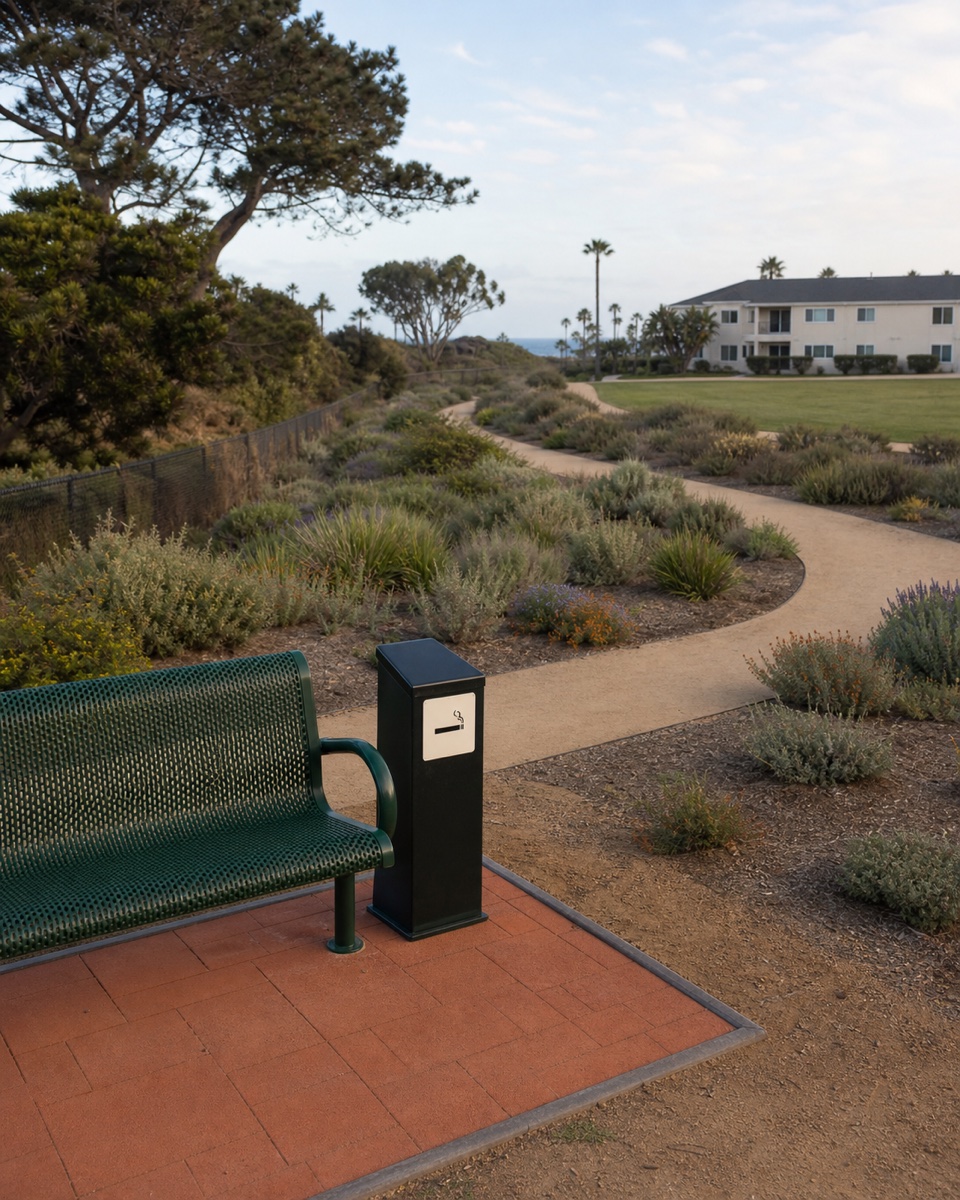
A designated smoking area is optional
An owner or HOA may elect not to provide any smoking area. If one is designated, it must:
- Be outdoors and unenclosed.
- Sit at least 25 feet from a doorway, window, opening, or other vent into an enclosed area.
- Sit at least 25 feet from recreation areas such as pools, tennis courts, and picnic areas.
- Sit at least 25 feet from areas primarily used by children, such as playgrounds.
- Have a clearly marked perimeter.
- Have conspicuous identification signs.
- Include smoking-waste receptacles kept free of litter.
- Avoid overlap with any place where another law prohibits smoking.
Do not leave ashtrays or smoking-waste receptacles in a nonsmoking common area.
Before designating an area, review site dimensions, accessible paths, fire rules, neighboring property, smoke migration, resident accommodations, security, insurance, and HOA authority. A space that cannot meet every condition should not be labeled as an authorized area.
Build a complaint-response process
When an owner has knowledge of a potential violation, the code requires reasonable steps to investigate and enforce.
A practical process is:
- Record the complaint without promising a result.
- Ask for dates, times, locations, observations, and smoke-migration details.
- Preserve written complaints, photographs, video, incident logs, and maintenance records.
- Check the lease, addenda, notice delivery, signs, and property map.
- Consider whether the report implicates disability, medical, retaliation, domestic-violence, privacy, or fair-housing issues.
- Investigate neutrally; do not treat an accusation as established fact.
- Send a fact-specific written warning or cure communication when supported.
- Include the City’s free nicotine-dependence resources.
- Document follow-up and any repeated violation.
- Obtain legal review before a termination notice.
The City’s sample violation letter is useful, but it should be completed accurately. Specify whether the property has a compliant designated area. Avoid stating that a tenant smoked when the evidence establishes only an odor complaint.
Smoking enforcement is not automatic eviction authority
The required lease terms identify specified conduct as a material breach and contemplate a cure opportunity before a later nonrenewal or termination for a subsequent violation.
That does not eliminate California requirements. Before taking a possession step, review:
- Whether Chapter 6.15 covers the tenancy.
- Whether the required lease clauses are in the agreement or incorporated by law.
- What conduct occurred and who engaged in it.
- Whether the person was subject to the tenant’s control.
- Knowledge and intent where the clause requires them.
- Admissible evidence.
- Prior warning and genuine opportunity to cure.
- Waiver or inconsistent enforcement.
- California just-cause coverage.
- Local notice rules.
- Disability-accommodation obligations.
- Retaliation and discrimination risk.
- Correct notice content and service.
Law Laguna focuses on compliance, evidence, notices, documents, negotiation, and pre-litigation strategy. If a filed unlawful-detainer or other lawsuit is required, the firm can organize the matter for appropriate litigation counsel.
Disability and fair-housing requests need separate analysis
A resident may report that smoke worsens asthma, a respiratory condition, or another disability. Treat a request to change rules, location, enforcement, ventilation, or unit placement as a potential reasonable-accommodation matter.
The owner should:
- Recognize the request even if the resident does not use legal terminology.
- Use a prompt, documented interactive process.
- Request only information the law permits when disability or need is not apparent.
- Consider effective options.
- Avoid retaliation.
- Apply the smoking rule consistently while evaluating individualized needs.
The smoke-free ordinance and fair-housing law should be analyzed together. Do not promise a particular building condition, accuse another resident without support, or disclose one resident’s medical information.
Private enforcement creates real exposure
Smoking in violation of Chapter 6.15 is declared a public nuisance. The code also treats nonconsensual exposure to smoke occurring on or drifting into residential property as a nuisance.
After the required good-faith steps, an affected person may bring a civil case against a violating tenant or owner-occupant and seek actual damages, statutory damages, or a court order to stop the violation. The claimant generally must first give written notice and make a written request to stop at least 30 days before filing suit.
The chapter limits a direct damages claim against a compliant landlord or HOA for another occupant’s breach. That protection depends on full compliance with the ordinance’s applicable lease, notice, signage, investigation, and enforcement duties. It does not eliminate duties or claims under other law.
The City states that Police and Code Enforcement are not responsible for ordinary private enforcement. An owner should not wait for the City to resolve a resident complaint.
Common interest developments and sales
Chapter 6.15 separately addresses covered common interest developments.
Potential obligations include:
- Notice to owners.
- Nonsmoking units and common areas.
- Written notice to prospective buyers or renters.
- Required provisions in CC&Rs adopted or amended after January 1, 2025.
- Signs.
- Investigation and enforcement.
- Distribution of cessation resources.
A condominium landlord may be subject to both the rental-property provisions and the HOA’s governing documents. A sale file should include the required smoke-free notice, current governing documents, complaint history, enforcement records, and any designated-area map.
Acquisition and portfolio diligence
Before buying or taking over management of a Carlsbad multifamily property, request:
- Unit count and legal-use records.
- All leases, addenda, renewals, and month-to-month notices.
- January 2025 implementation notices and delivery proof.
- Sign inventory and photographs.
- Smoking-area site plan.
- Complaint and investigation log.
- Warnings and cure notices.
- Nicotine-resource materials.
- Fair-housing requests and response log, handled with appropriate privacy safeguards.
- HOA notices, rules, CC&Rs, minutes, and enforcement records.
- Insurance and fire-safety communications.
- Pending claims or demand letters.
The purchase agreement and management transition should allocate correction work, resident communications, open complaints, and document retention.
Common Carlsbad owner mistakes
Using a generic no-smoking sentence
Chapter 6.15 requires multiple lease concepts, including common-area conduct, controlled persons, other smoking laws, cure, reporting, and third-party-beneficiary status.
Treating a balcony as outside the unit
The code includes exclusive-use areas such as balconies, porches, decks, and patios.
Designating an area without measuring
The 25-foot rules, perimeter, signs, receptacles, and other-law restrictions all matter.
Ignoring an odor complaint
Knowledge triggers investigation and reasonable enforcement duties. Document what was reported and what the owner did.
Moving directly from accusation to termination
Evidence, cure, repeat conduct, just cause, fair housing, notice, and service require separate analysis.
Assuming the original 2024 ordinance is the last word
The code’s definitions were amended in February 2026. Check the current codified chapter at publication and before action.
How Law Laguna can help you move forward
Depending on scope, Law Laguna can:
- Determine property and tenancy coverage.
- Review and update leases and smoking addenda.
- Prepare resident notices and delivery records.
- Audit signs and a designated-area plan.
- Build a complaint and investigation protocol.
- Review evidence and warning communications.
- Analyze accommodation and retaliation risk.
- Review a proposed cure or termination strategy.
- Conduct acquisition or portfolio compliance diligence.
- Organize a matter for litigation counsel if a filed action becomes necessary.
Related guidance
- San Diego County landlord law for property owners
- Residential lease drafting and review for California property owners
- Required rental disclosures and addenda for California landlords
Questions property owners often ask
Does the Carlsbad rule apply to a duplex?
A duplex designed exclusively for two independent households is generally excluded, subject to the code’s health-care-facility exception. Other laws and private lease restrictions may still apply.
Does it apply to a detached home with an ADU?
The current definition excludes a one-family home with an ADU or junior ADU permitted under specified state or City law, subject to the health-care-facility exception. Confirm the units’ legal status and current code.
Can a tenant smoke on a private balcony?
Not when the unit is covered by the prohibition. Associated balconies, porches, decks, garages, parking spaces, and patios fall within the code’s unit definition.
Must a landlord provide a smoking area?
No. A designated outdoor area is optional. If provided, it must satisfy every location, perimeter, signage, receptacle, and overlap condition.
What should an owner do after a complaint?
Record and investigate it neutrally, check documents and signs, consider fair-housing issues, send a supported written warning or cure communication, distribute City cessation resources, and document follow-up.
Can a smoking violation support termination?
Potentially, but not automatically. Review the required lease terms, proof, cure opportunity, repeat conduct, California just-cause law, fair housing, retaliation, notice content, and service before acting.
Does the City enforce every smoking complaint?
No. The City’s public guidance says ordinary enforcement is private and that Police and Code Enforcement are not responsible for it. Owners should maintain their own compliant response process.
Can an affected resident sue the landlord?
Chapter 6.15 limits a damages claim against a landlord for another occupant’s breach when the landlord has fully complied with the chapter. Other claims and laws may still apply, and the facts require individual review.
Review the complete property system
Bring the address, unit and occupancy records, leases, renewals, resident notices, delivery proof, sign photographs, site map, smoking-area plan, complaints, evidence, warnings, accommodation requests, HOA documents, and proposed next step.